
Choosing case management software for social work means balancing a lot of competing priorities — ease of use, HIPAA compliance, features that actually match your workflow, and a price that fits your budget. Most "best of" lists are written by people who've never worked a caseload, which is why so many tools on those lists feel nothing like what social workers actually need.
This list takes a different approach. We evaluated platforms based on what matters most in social work practice: how quickly you can learn the tool, whether it handles sensitive client data safely, whether it's built for social services or just adapted from another industry, and what it actually costs. If you're looking specifically for budget-friendly options, our separate guide to free and low-cost case management solutions covers that in more detail.
For a deeper look at what features to evaluate — beyond specific products — our social work case management software buyer's guide walks through the decision framework step by step.
| Platform | Best For | Pricing | HIPAA Compliant |
|---|---|---|---|
| Notehouse | Ease of use and affordability | $12/mo | Yes |
| Casebook | Comprehensive social services agencies | Custom | Yes |
| Penelope | Clinical and counseling settings | Custom | Yes |
| CharityTracker | Community nonprofits and referral networks | ~$20/user/mo | Contact vendor |
| Apricot by Bonterra | Outcome reporting and funder compliance | Custom | Contact vendor |
| Sumac | Small nonprofits wanting all-in-one | ~$35/mo | Contact vendor |
| Google Docs + Drive | Free starting point | Free | No |
Best for: Ease of use and affordability Pricing: Free 2-week trial, then $12/month (Plus plan) HIPAA compliant: Yes
Notehouse was built specifically for social workers, counselors, and case managers who need a tool that's simple enough to learn in minutes but structured enough to handle real caseloads. It's designed around the way helping professionals actually work — client profiles, chronological case notes, tagging, task tracking, and demographic fields — without the enterprise bloat that makes other platforms feel like they were built for a different industry.
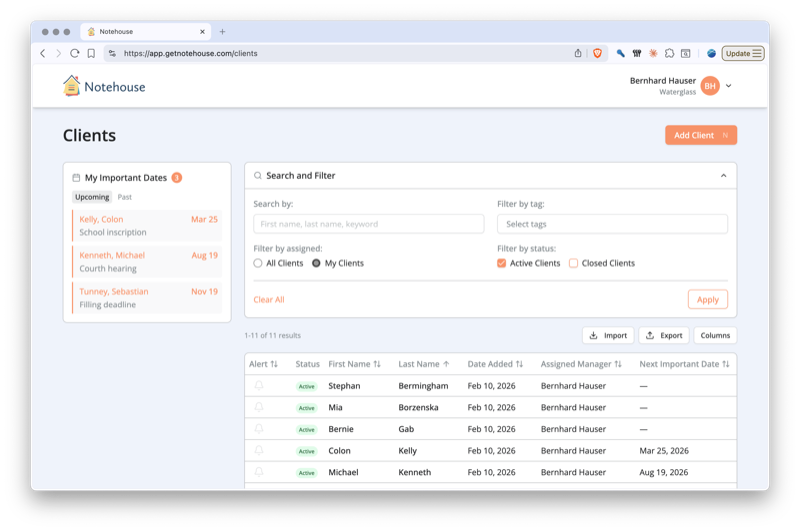 Notehouse organizes client profiles, case notes, and tags in an interface designed specifically for social workers.
What sets Notehouse apart is its focus on usability. There's no lengthy onboarding process, no certification required, and no features you'll never touch. You sign up, start a case, and begin documenting. For social workers who've been burned by clunky systems, that simplicity is the selling point. It's also one of the most affordable options available, and it's HIPAA compliant — a combination that's surprisingly rare. Read more about why ease of use matters in case management. If you want a closer look at how it fits your field, Notehouse has a dedicated overview of its case management software for social workers.
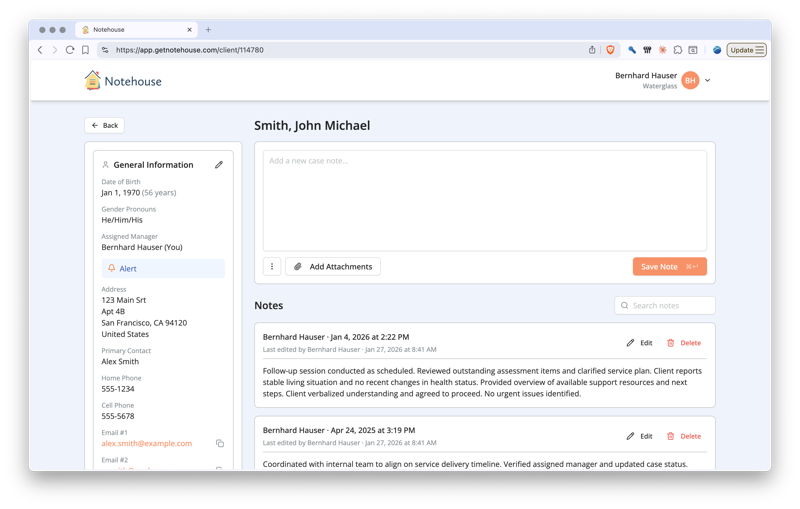 Chronological case notes, tagging, and task tracking — without the enterprise bloat.
Best for: Comprehensive social services agencies Pricing: Custom (contact for quote) HIPAA compliant: Yes
Casebook is designed for social services organizations that need a full-featured platform for intake management, case planning, service tracking, and outcomes reporting. It's built with social work workflows in mind and offers configurable forms that can be tailored to different program types.
The trade-off is complexity. Casebook has more features than most small teams will use, and the learning curve reflects that. Implementation typically involves a setup process with vendor support, which can take weeks. Pricing isn't published, which usually signals enterprise-level costs. If you're a larger agency with dedicated admin staff, Casebook is worth evaluating. If you're a small team or solo practitioner, it's likely more than you need.
Best for: Clinical and counseling settings Pricing: Custom (contact for quote) HIPAA compliant: Yes
Penelope is a case management platform with strong roots in clinical settings. It includes scheduling, clinical assessments, billing integration, and outcome measurement tools — features that matter most when your work involves therapy sessions, treatment plans, or clinical documentation.
Penelope works well for organizations that straddle the line between social services and clinical care. The scheduling and billing modules are genuinely useful for agencies that handle those workflows internally. However, if your work is primarily community-based case management without a clinical component, many of Penelope's strongest features won't apply. The pricing is quote-based and generally falls at the higher end.
Best for: Community-based nonprofits and referral networks Pricing: Starting around $20/user/month HIPAA compliant: Contact vendor for details
CharityTracker is built for community-based organizations that need to track clients, share referrals, and coordinate services across multiple agencies. Its standout feature is its community collaboration model — organizations in the same network can share client information (with appropriate permissions) to reduce duplication and improve coordination.
CharityTracker is a strong choice for social workers in community action agencies, United Way affiliates, or coalitions where multiple providers serve the same population. Client profiles, case notes, and referral tracking are solid, though the interface feels a bit dated compared to newer platforms. It's less suited for clinical settings or organizations that need robust reporting beyond basic outputs.
Best for: Outcome reporting and funder compliance Pricing: Custom (generally higher tier) HIPAA compliant: Contact vendor for details
Apricot (formerly Social Solutions Apricot) is designed for nonprofits that need to track and report on program outcomes — particularly for grant-funded programs where demonstrating impact is tied to continued funding. It offers configurable forms, automated report generation, and dashboards that can be tailored to specific funder requirements.
The platform is powerful for organizations with dedicated data or evaluation staff who can set up and maintain custom forms and reports. For smaller teams without that capacity, the initial configuration can be daunting, and the ongoing maintenance of custom forms requires attention. Pricing is on the higher end and typically involves annual contracts.
Best for: Small nonprofits wanting an all-in-one platform Pricing: Starting around $35/month (base plan) HIPAA compliant: Contact vendor for details
Sumac positions itself as an all-in-one nonprofit management platform that combines case management with donor management, volunteer tracking, and communications. For very small organizations that need a single system to handle multiple functions, this integrated approach can reduce the need for separate tools.
The case management functionality in Sumac is serviceable but not as deep as platforms built exclusively for case work. If your primary need is case management, a purpose-built tool will likely serve you better. But if you're a small nonprofit juggling multiple operational needs with a limited budget, Sumac's breadth may be more valuable than depth.
Best for: Free starting point with zero barrier to entry Pricing: Free (personal) or low-cost nonprofit plans HIPAA compliant: No (not in standard configuration)
Sometimes the right starting point is the simplest one. Google Docs and Drive give you shared folders, templates, version history, and basic access controls — enough to establish consistent documentation practices when you have no budget for dedicated software. For a detailed look at when this approach works and when you've outgrown it, see our Google Docs alternative guide.
The limitations are real, though. Google Workspace is not HIPAA compliant in its standard configuration (Google does offer a HIPAA-eligible configuration for paid business plans, but setup requires specific configuration and a BAA). There's no built-in client record structure, no tagging system, and no reporting. You're essentially building a filing system from scratch. It works as a starting point, but most teams eventually need something more purpose-built.
The right platform depends on your specific situation more than on any ranked list.
 The right platform depends on your caseload size, budget, and compliance requirements.
Solo practitioners and small teams will generally do best with tools that prioritize simplicity and affordability. Notehouse and CharityTracker both fit this profile, with Notehouse being the stronger choice for HIPAA compliance and ease of use.
Clinical settings that need scheduling and billing integration should look closely at Penelope. If clinical features aren't a core need, the additional complexity isn't worth it.
Larger agencies with reporting requirements should evaluate Apricot and Casebook, particularly if grant compliance and outcome reporting drive your software needs.
Organizations with zero budget can start with Google Docs and a clear folder structure, then graduate to a purpose-built tool as resources allow.
Whatever you choose, the features that matter most are the ones covered in our must-have features guide: usability, security, customization, and collaboration. Everything else is secondary. And if you're exploring how case management software fits into the broader landscape of social work practice, that context can help you make a more informed decision. Notehouse also has dedicated overviews of its nonprofit case management software and social services case management software if one of those settings is a better fit.
Note: Pricing, features, and compliance certifications are subject to change. Always verify current information directly with vendors. Compliance requirements vary by jurisdiction, setting, and role.

Notehouse is a simple, yet powerful case management solution for teams. Get started with a free trial, no credit card required.
Explore Notehouse ›Powerfully Simple Case Management You'll Actually Use

4.7 stars from 101 customers reviews
Case Management Software for nonprofit leaders, counselors, managers, and social workers.
© 2026 Waterglass UK Ltd.


Free Tools