

One of the fastest ways to understand a client's situation is to see it visually. That's exactly what an ecomap does — it maps out the people, systems, and resources in a client's environment and shows the quality of those relationships at a glance. A quick sketch on paper or a whiteboard can reveal patterns that pages of narrative notes might miss: where the support is, where the stress is, and where the gaps are.
Ecomaps are used across social work, counseling, family therapy, and case management. This guide explains how to read and create them, with concrete examples you can adapt to your own practice.
An ecomap is a visual diagram that shows a client (or family) at the center and their relationships to the systems and people around them. It was developed by social work professor Ann Hartman in 1978 as a tool for assessing families in child welfare settings, but it's since been adopted across virtually every area of social work practice.
The purpose of an ecomap is to quickly identify support networks, sources of stress, resource gaps, and relationship patterns. It's especially useful during assessment — it gives both you and the client a concrete picture of their environment that you can discuss together.
Ecomaps are different from genograms, though the two are often used together. A genogram maps family structure and history across generations (think of it as a detailed family tree with relationship patterns). An ecomap maps the client's current connections to external systems — employers, schools, healthcare providers, religious communities, social services, friends, and extended family. Where a genogram looks inward and backward, an ecomap looks outward and at the present.
Ecomaps use a simple visual language that conveys a lot of information once you know the conventions. Here's what each element represents.
The center circle represents the client or family unit. This is usually drawn larger than the surrounding circles and placed in the middle of the page.
Surrounding circles represent the systems, people, and resources in the client's environment. Each one is labeled — "Employer," "School," "Mother," "Church," "Mental Health Provider," "Housing Authority," and so on.
The lines between circles indicate the nature of each relationship.
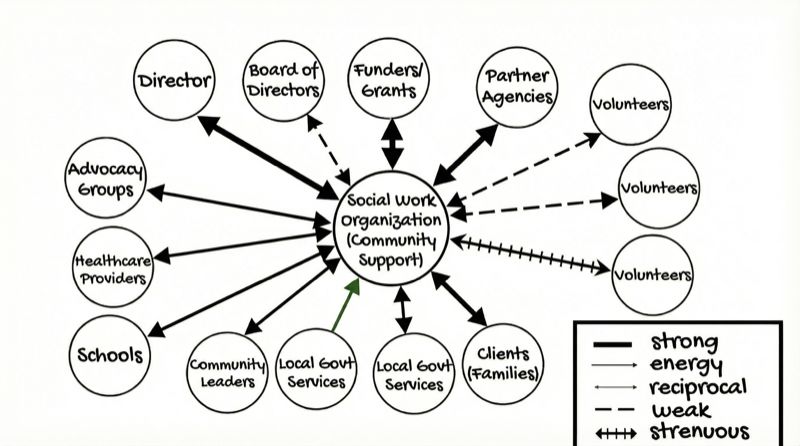 Different line styles represent the nature of each connection — from strong and supportive to stressful and draining.
| Line Type | Meaning | What It Tells You |
|---|---|---|
| Solid line | Strong, positive connection | Reliable source of support |
| Dashed line | Weak or tenuous connection | Exists but not dependable |
| Zigzag/wavy line | Stressful or conflictual | Source of tension or drain |
| Double line | Very strong bond | Deeply significant relationship |
| Arrow toward client | Resources flowing in | Client is receiving support |
| Arrow away from client | Energy flowing out | Client is giving more than receiving |
| Bidirectional arrows | Reciprocal relationship | Mutual exchange of support |
| No line (gap) | Absent connection | Missing resource or relationship |
The combination of line type and arrow direction tells you a great deal. A dashed line with an arrow pointing away from the client toward "Extended Family" suggests the client is putting energy into a weak family connection without getting much back. A solid line with arrows in both directions to "Employer" suggests a mutually supportive work relationship.
Here's an example of what a completed ecomap looks like for a typical family, with different line types showing the nature of each relationship:
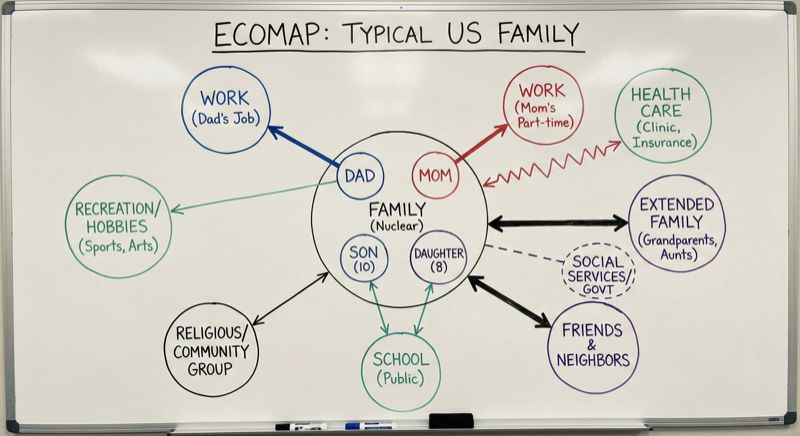 A completed ecomap reveals at a glance where support is strong, where stress is concentrated, and where gaps suggest intervention opportunities.
Maria is a 34-year-old single mother who recently relocated to a new city with her two children, ages 6 and 9. She was referred to your agency after her youngest was flagged for attendance issues at school. Here's what her ecomap reveals.
Strong connections. Maria has a solid, reciprocal relationship with her employer. She's been at her job for three months and describes her supervisor as supportive and understanding of her parenting responsibilities. She also has a strong bond with her church community, which she found shortly after moving. The church has been her primary social outlet and has connected her with a food pantry.
Tenuous connections. Maria's relationship with her children's new school is weak. She's attended one parent-teacher meeting but doesn't feel connected to the teachers or staff. Her connection to her new primary care provider is also tenuous — she's had one appointment but hasn't established consistent care for herself or the children.
Stressful connections. Maria has an ongoing, conflictual relationship with her ex-partner, who lives in her previous city. Communication about the children is a consistent source of stress, and custody arrangements are informal and contentious.
Gaps. There's no connection to mental health services, even though Maria describes feeling overwhelmed and isolated. There's no connection to after-school programs or childcare, which contributes to the attendance issues. Her extended family is in another state, and contact is infrequent.
What this ecomap tells a social worker. Maria's support system is thin and geographically new. Her strongest connections — employer and church — are positive but recent. The school relationship needs strengthening to address the attendance concern directly. The absence of mental health services and childcare support represent clear intervention opportunities. And the stressful ex-partner dynamic is draining energy from an already stretched system.
 Stable connections like a supportive school counselor can serve as anchor points for building resilience around a client in foster care.
Jaylen is a 16-year-old in foster care who has been in his current placement for eight months. His caseworker requested an updated assessment after Jaylen's grades dropped and he was involved in a school disciplinary incident.
Strong connections. Jaylen has a very strong bond with his foster family, particularly his foster mother. He also has a strong, positive relationship with his school counselor, who has been consistent and available throughout the school year.
Tenuous connections. Jaylen's connection to his peer group is weak and inconsistent. He describes having acquaintances but no close friends at his current school. His relationship with his biological siblings, who are in a different placement, is maintained through monthly supervised visits but feels distant. His connection to extracurricular activities is tenuous — he joined the school's basketball team briefly but stopped attending.
Stressful connections. The relationship with his biological mother is a source of significant stress. Visits are inconsistent, and cancellations trigger emotional and behavioral responses. His relationship with the school's disciplinary system is also stressful — the recent incident has put him on the administration's radar in a way that feels punitive rather than supportive.
Gaps. Jaylen is not connected to mental health services despite a documented history of trauma. There's no connection to a mentor or positive adult male role model outside the foster home. He has no connection to vocational or independent living programming, which will become increasingly important as he approaches aging out.
What this ecomap tells a social worker. Jaylen's foster placement is a genuine strength — it's his most stable and supportive relationship. The school counselor is another anchor point. But the peer isolation, inconsistent biological family contact, and absence of mental health services create vulnerability. The grade drop and disciplinary issue likely connect to the stressful dynamics rather than being standalone problems. Interventions should focus on stabilizing the biological mother relationship, connecting Jaylen to therapy, and building peer connections — perhaps through reengagement with sports or a mentorship program.
Creating an ecomap is straightforward, and it can be done on paper, a whiteboard, or digitally. Here's the process.
Step 1: Place the client in the center. Draw a circle in the middle of the page and write the client's name (or "Family" if you're mapping a family unit). Make this circle slightly larger than the others.
Step 2: Identify the systems and people in the client's life. Think broadly — family members, friends, employer, school, healthcare providers, religious community, social services, legal system, neighborhood, recreational activities. Ask the client to help you brainstorm. You'll often discover connections (or absences) that weren't mentioned in the intake.
Step 3: Draw surrounding circles. Place a circle for each system or person around the center, labeling each one. There's no required number — include whatever is relevant to the client's situation.
Step 4: Draw relationship lines. Connect each surrounding circle to the center using the appropriate line type: solid for strong, dashed for weak, zigzag for stressful, double for very strong. If there's no relationship where one should exist, leave it unconnected and make a note.
Step 5: Add directional arrows. On each line, add arrows to show the flow of energy, support, or resources. Arrows toward the client indicate support flowing in. Arrows away indicate the client is giving or expending energy. Bidirectional arrows show reciprocity.
Step 6: Review with the client. This is one of the most valuable steps. Show the completed ecomap to the client and discuss it together. Clients often have reactions — "I didn't realize how few supports I have" or "Seeing it like this, it makes sense why I'm exhausted." The ecomap becomes a collaborative tool for identifying priorities and planning next steps. For more on using collaborative assessment tools, see our guide on note-taking methods for human services.
An ecomap is a powerful assessment tool, but its findings should also be reflected in your written documentation. The visual format captures patterns quickly, while narrative notes provide the detail and context that your records need.
When translating ecomap findings into case notes, focus on the key themes: where the client's strongest supports are, where the most significant stressors lie, and where the gaps suggest opportunities for intervention. You don't need to describe every circle and line — summarize the patterns that inform your service plan.
Ecomaps pair naturally with biopsychosocial assessments. The ecomap gives you the visual overview of the social domain, while the biopsychosocial assessment provides the structured narrative across all three domains. Used together, they create a comprehensive picture of the client's situation.
For organizing and storing ecomaps alongside other assessment documents, a tool like Notehouse lets you attach files to client records, tag assessments for easy retrieval, and keep everything in one secure, searchable location. For broader guidance on structuring your client documentation, see our case management best practices guide and our overview of social worker resources.
Note: The examples in this guide use fictional clients. Assessment practices and documentation requirements vary by setting, jurisdiction, and agency policy. Always follow your specific professional guidelines.


Notehouse is a simple, yet powerful case management solution for teams. Get started with a free trial, no credit card required.
Explore Notehouse ›Powerfully Simple Case Management You'll Actually Use

4.7 stars from 101 customers reviews
Case Management Software for nonprofit leaders, counselors, managers, and social workers.
© 2026 Waterglass UK Ltd.


Free Tools