
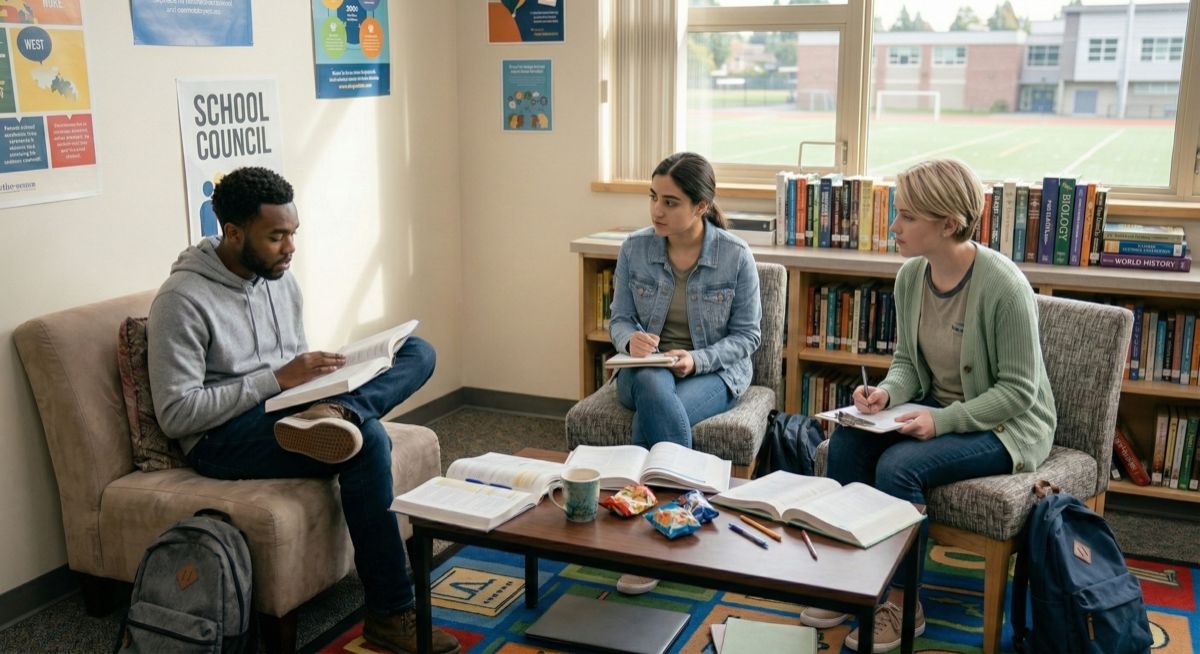
Walk into almost any school in the country and you'll find a school counselor somewhere in the building — meeting with a student who's struggling, talking a parent through a college application, or pulling together a crisis response team after something difficult happened over the weekend. The role is broad, the caseloads are large, and the work is rarely what the job title suggests to outsiders.
If you're considering school counseling as a career, working alongside school counselors in another professional capacity, or simply trying to understand what this position actually involves, this guide breaks it all down — from the daily routine to the documentation demands to what the career looks like over time.
At the highest level, school counselors support the academic, social-emotional, and career development of students. But that description doesn't quite capture how varied and demanding the day-to-day work is.
The American School Counselor Association (ASCA) defines the school counselor's role around four core domains: academic development, career development, social-emotional development, and equity and access. In practice, that means a school counselor might spend one hour working through a student's IEP accommodations, another running a grief support group, another meeting with a parent about a college financial aid appeal, and another responding to a student in crisis — all before lunch.
No two days are the same. That's one of the draws of the profession for many counselors, and one of its most significant challenges.
Academic support is often the most visible part of the job, especially at the middle and high school levels. School counselors help students select courses that align with their goals and meet graduation requirements. They monitor academic progress and step in early when students start falling behind. At the high school level, counselors guide students through the college application process — helping them research programs, complete applications, write essays, and understand financial aid options.
This work sounds straightforward on paper. In practice, it means knowing the graduation requirements cold, tracking dozens of at-risk students before they reach a failing threshold, and finding time for seniors in the middle of October when everyone wants an appointment at the same time.
School counselors provide individual and group counseling to students experiencing personal difficulties — anxiety, depression, family instability, grief, friendship conflicts, bullying, and more. This is different from long-term therapy (which is typically outside the scope of the role), but it's substantive support that often makes a meaningful difference in a student's ability to function in school.
Group counseling is a practical way for counselors to reach more students at once. "Lunch bunches" — small groups meeting over lunch to work on social skills, stress management, or friendship-building — have become a popular model, especially at the elementary level. Classroom lessons on social-emotional topics are another way counselors extend their reach beyond one-on-one sessions.
 When one-on-one time is limited, group sessions and classroom lessons help counselors reach more students with social-emotional support.
At the secondary level, preparing students for life after high school is a central part of the role. This includes college and vocational exploration, resume and interview skills, career interest assessments, and connecting students with job shadowing or internship opportunities. For students who aren't heading to four-year colleges, counselors help them navigate trade programs, community college, apprenticeships, and direct workforce entry.
Career readiness work often extends to families as well. Many parents are navigating the college application process for the first time, and the counselor's ability to clearly explain FAFSA deadlines, scholarship options, and admission requirements is genuinely valuable support.
School counselors are a critical part of the crisis response infrastructure in schools. When a student expresses suicidal ideation, when a traumatic community event affects students, when a peer dies — the school counselor is often the first professional point of contact and the coordinator of the school's response.
This is the part of the job that weighs heaviest on many counselors. Crisis intervention requires training, composure, and the ability to make high-stakes judgments quickly. It also requires careful documentation and coordination with parents, administrators, and outside providers. The intensity of this work — and the fact that it can happen on any given day with no warning — is a significant contributor to burnout in the profession.
School counselors also serve as advocates within their buildings and districts, pushing for equitable access to advanced coursework, identifying students who've been overlooked, and working to change policies or practices that create barriers for students. This systems-level work is less visible but essential — especially in schools with high concentrations of students from marginalized communities.
These three roles are often confused, and the confusion is understandable — they all support student well-being and they often collaborate closely. But they have distinct training, scopes of practice, and primary responsibilities.
School counselors focus on academic, career, and social-emotional development. They work with the full student body, delivering programming and counseling at a population level. Their training is typically in school counseling programs accredited through CACREP (Council for Accreditation of Counseling and Related Educational Programs), and they hold state-issued school counseling credentials rather than clinical licensure.
School social workers extend beyond the school building to address the family and community factors affecting a student's ability to learn. They conduct home visits, connect families with community resources, work with families involved in the child welfare system, and address issues like poverty, housing instability, abuse, and neglect. Their training is in social work (typically an MSW), and they bring the "person-in-environment" lens that's central to the social work profession. Schools in more resourced districts may have both a school counselor and a school social worker serving the same student population.
School psychologists are trained to conduct formal psychological and psychoeducational assessments — evaluating students for learning disabilities, ADHD, autism spectrum disorder, and emotional-behavioral disorders. They play a central role in the special education eligibility process and in developing IEP goals. Most school psychologists hold a specialist-level degree (EdS) or doctorate.
In practice, these roles overlap. A school counselor, social worker, and psychologist might all meet together as part of a student support team, each contributing from their distinct area of expertise. The best-functioning schools have all three.
Here's where the gap between what school counselors are supposed to do and what they're actually able to do becomes stark.
ASCA has recommended a 250:1 student-to-counselor ratio since 1965. The most recent national data shows the actual ratio is 372:1 for the 2024-2025 school year. At the elementary and middle school levels, ratios commonly run between 571 and 694 students per counselor. Only four states — Colorado, Hawaii, New Hampshire, and Vermont — meet the ASCA recommendation.
What does a 400:1 ratio feel like in practice? It means the average counseling session is constantly interrupted by the next urgent thing. It means the student who could benefit from weekly check-ins gets monthly ones, if that. It means college planning conversations that should take an hour get compressed into fifteen minutes. And it means crisis intervention — which has no schedule and can't be deferred — consumes the time that was supposed to go to preventive work.
This is one of the most significant structural challenges in the profession, and it's one counselors navigate every single day. Setting sustainable boundaries becomes not just a matter of personal well-being but a professional necessity when the demand structurally exceeds the capacity to respond.
 With national student-to-counselor ratios averaging 372:1, school counselors must make intentional choices about where to direct their limited time each day.
Documentation is a significant and often underappreciated part of the school counselor's job. The records counselors keep serve multiple purposes: they support continuity of care, create accountability, protect the student and the counselor legally, and provide the data school administrators and districts need to evaluate programs.
School counselors typically maintain several categories of records:
Session notes and case notes document individual counseling contacts — when the student was seen, what was discussed, what actions were taken, and any follow-up needed. Under FERPA, school counselors can maintain "sole possession records" — private notes that function as a personal memory aid and are not shared with others — that fall outside the definition of an educational record parents have the right to access. However, once those notes are stored in a shared system or shared with another school official, they become part of the educational record and are subject to FERPA disclosure rules.
Crisis documentation is particularly important. When a student presents with suicidal ideation or is involved in a safety incident, the counselor's documentation of their assessment, the actions taken, who was notified, and the follow-up plan is critical for both student safety and professional protection.
College and academic records track course completion, graduation progress, test scores, and college application timelines. In many schools, counselors are responsible for submitting transcripts and school counselor recommendations to colleges — records that must be accurate and timely.
Group counseling records document the composition of groups, attendance, and the focus of each session.
Data collected to evaluate the counseling program — number of students served, types of concerns addressed, academic outcomes for students who received support — is increasingly important for demonstrating value and making the case for adequate staffing.
For counselors managing 300 to 500+ students, documentation is a genuine burden. Thorough notes require time that often isn't available, and incomplete records create both professional risk and gaps in care. The same tension between client contact and paperwork that social workers in other settings describe is very much present in school settings.
Counselors who develop consistent, efficient note-taking habits early in their careers — and who use tools designed to make documentation faster without sacrificing quality — are better positioned to sustain themselves over the long term. For practical strategies on building an efficient system, our guide on developing an efficient note-taking system is a useful starting point.
Given the volume of students school counselors are responsible for and the breadth of what they need to track, having an organized system isn't optional — it's essential to doing the job well.
Many school counselors use their district's student information system for academic records, but those systems are often clunky, not designed for counseling notes, and shared in ways that complicate confidentiality decisions. A separate, dedicated tool for counseling documentation gives counselors more control over their records and makes it easier to keep notes private, organized, and quickly accessible.
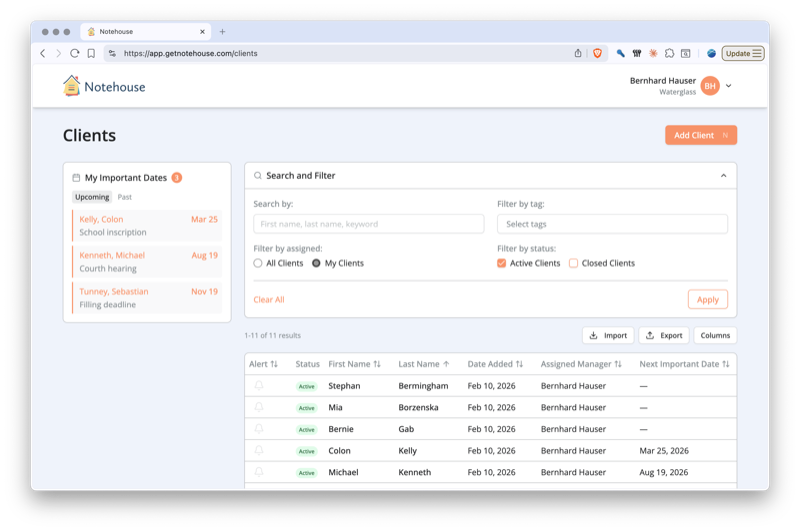 A dedicated note-taking tool helps school counselors keep track of session notes, follow-ups, and student histories across a large caseload.
Notehouse is built for exactly this kind of work — professionals managing large numbers of client relationships who need to document quickly, organize clearly, and find information fast when they need it. For a school counselor juggling several hundred students, being able to pull up a student's history in seconds before a parent calls makes a real difference. The platform is designed to be simple enough that documentation doesn't become a second job, while being secure enough to trust with sensitive information.
For counselors weighing different tool options, our overview of must-have features for social work software covers the capabilities that matter most for human services professionals.
Becoming a school counselor requires graduate-level education. Nearly all states require a master's degree in school counseling or a closely related field, along with state-issued certification or licensure. Requirements vary by state, but the general pathway looks like this.
A bachelor's degree is the starting point, typically in psychology, education, social work, or a related field. After that, a master's program in school counseling (generally 48-60 credit hours) provides the specialized training for the role. These programs include coursework in counseling theory and techniques, human development, group counseling, career development, multicultural counseling, assessment, and school counseling program development.
Supervised fieldwork is a required component — most programs require 600-700 hours of supervised practice in a school setting, completed during a practicum and internship. This hands-on experience is where candidates apply their training in real school environments, typically under the supervision of a credentialed school counselor.
After completing their degree, candidates apply for their state's school counseling credential or license. Some states also require one to two years of teaching experience before granting a school counseling credential, though this requirement has become less common.
Continuing education is required to maintain licensure in most states, typically 60 hours every five years, though requirements vary.
For those deciding between school counseling and other helping professions, shouldibecomeasocialworker.com has resources on adjacent career paths worth exploring.
The career outlook for school counselors is steady. According to the Bureau of Labor Statistics, employment of school and career counselors is projected to grow 4% from 2024 to 2034, about as fast as the average for all occupations. Demand is being driven by increased awareness of student mental health needs, expanded school mental health funding in many states, and retirements in a profession where the workforce skews older.
The median annual wage for school counselors in elementary and secondary schools was $76,960 in May 2024, according to BLS data. That's meaningfully higher than the overall median for counselors ($65,140) because school counselor positions are predominantly full-year salaried roles with benefits, often in districts that follow teacher salary schedules.
Salaries vary significantly by region, school level, and years of experience. For detailed data by state, socialworksalaries.com compiles compensation data across human services roles in an easy-to-navigate format. Generally, counselors in wealthier districts and coastal metro areas earn more, while rural and lower-income districts — where the need is often greatest — tend to pay less.
School counselor positions typically include the same benefits package as teachers: health insurance, pension contributions, summers off (though many counselors work over the summer on professional development or program planning), and access to Public Service Loan Forgiveness for those with federal student loans.
School counseling is a career for people who are genuinely energized by working with young people and who can thrive amid constant context-switching. You'll move between a student who needs emotional support, a parent who wants to argue about course placement, a college application deadline, and an unexpected crisis — sometimes within the same hour.
The caseload realities are difficult, and it's worth going in with clear eyes about that. The gap between what counselors could do with adequate staffing and what they're able to do in most schools is real and frustrating. At the same time, the counselors who find longevity in this work tend to be those who develop strong systems, clear boundaries, and a realistic sense of where they can have the most impact on any given day.
If you're drawn to a school environment, want to support the full arc of student development, and are comfortable with both the relational and administrative sides of the work, school counseling is a meaningful and stable career. And whether you're just starting out or five years in, having the right tools for documentation and organization is one of the most practical investments you can make in your ability to do this work well and sustain it over time. See how Notehouse is built for school counselors managing large caseloads.


Notehouse is a simple, yet powerful case management solution for teams. Get started with a free trial, no credit card required.
Explore Notehouse ›Powerfully Simple Case Management You'll Actually Use

4.7 stars from 101 customers reviews
Case Management Software for nonprofit leaders, counselors, managers, and social workers.
© 2026 Waterglass UK Ltd.


Free Tools